 May 21, 2026
  7 min read


 Back to Blog
Neuroscience & Brain Health
Recognizing symptoms and navigating specialized brain health care.
By Dr. William “Wes” Alden • Based on Nature Communications (Nov 2025) • 12 min read
When memory changes begin affecting daily life, simple tasks become confusing, or unexplained neurological symptoms appear, patients and families often ask an important question: Who should we see? Searching terms like dementia specialist near me or an Alzheimer’s specialist near me or me is usually the first step, but understanding what a neurodegenerative specialist actually does can help patients make informed decisions about care.
As a physician-scientist working in neurodegenerative medicine, I’ve seen firsthand how early recognition and comprehensive care can significantly impact a patient’s quality of life. Neurodegenerative diseases rarely affect only the brain. They often influence emotions, movement, sleep, nutrition, behavior, relationships, and overall wellbeing. Because of that, patients deserve a broader, more holistic approach.
This guide explains what a neurodegenerative specialist is, what conditions they treat, when patients should seek one out, and what to expect during evaluation and treatment.
Understanding Neurodegenerative Disease
Neurodegenerative diseases are conditions in which nerve cells in the brain or nervous system gradually lose function over time. Because neurons typically do not regenerate effectively, these conditions often progress slowly and require ongoing medical management.
Common Neurodegenerative Disorders
- Alzheimer's disease
- Dementia
- Parkinson's disease
- Huntington's disease
- Lewy body dementia
- Frontotemporal dementia
- Multiple system atrophy
- Amyotrophic lateral sclerosis (ALS)
Common Symptoms
Each condition affects different areas of the nervous system and may create varying symptoms, including:
- Memory loss
- Difficulty speaking
- Difficulty speaking
- Balance problems
- Tremors
- Confusion
- Mood disturbances
- Sleep disruptions
- Cognitive decline
Because many symptoms overlap, accurate diagnosis can be challenging without specialized expertise.
What Is a Neurodegenerative Specialist?
A neurodegenerative specialist is a physician with advanced expertise in diagnosing, treating, and managing diseases involving progressive degeneration of the nervous system. Unlike general healthcare providers who address a broad range of medical conditions, these specialists focus specifically on disorders affecting cognition, memory, movement, and neurological function.
Each condition affects different areas of the nervous system and may create varying symptoms, including:
- Understand symptoms
- Identify disease progression patterns
- Develop treatment strategies
- Manage complications
- Improve quality of life
- Coordinate long-term care
Many specialists combine principles from neurology, internal medicine, psychiatry, cognitive medicine, and integrative healthcare. In my own clinical approach, neurodegenerative care involves understanding the patient as a whole person rather than treating isolated symptoms.
How Is a Neurodegenerative Specialist Different From a Neurologist?
🧠
General Neurologist
Treats a wide range of nervous system disorders: headaches, stroke, seizures, neuropathy, multiple sclerosis, and sleep disorders.
🔬
Neurodegenerative Specialist
Focuses deeply on progressive diseases affecting cognition and brain function, with additional training in memory disorders, dementia care, and advanced neurological imaging.
For patients searching online for a dementia specialist near me, they are often looking for precisely this level of specialized expertise — including behavioral symptoms and complex treatment planning.
Conditions a Neurodegenerative Specialist Treats
Alzheimer's Disease
Alzheimer’s disease is the most common cause of dementia and typically begins with subtle memory changes before progressing over time. Families frequently search for an Alzheimer’s specialist near me after noticing early signs.
- Repeating questions
- Forgetting appointments
- Difficulty completing familiar tasks
- Trouble finding words
- Confusion about time or location
Dementia
Dementia itself is not a single disease. It is a broader term describing symptoms affecting memory, thinking, and daily functioning. Different forms include vascular dementia, Lewy body dementia, frontotemporal dementia, and mixed dementia. Correct diagnosis matters because treatment approaches can vary significantly.
Parkinson's Disease
Although known primarily as a movement disorder, Parkinson’s can also affect memory, mood, sleep, cognition, and autonomic function.
Lewy Body Dementia
Patients with Lewy body dementia may experience hallucinations, fluctuating cognition, Parkinson-like movement symptoms, and sleep abnormalities. This condition is often misdiagnosed without specialist evaluation.
Signs You Should See a Neurodegenerative Specialist
Patients often wait months or years before seeking specialty care. Earlier evaluation frequently provides better opportunities for planning and treatment. Consider an evaluation if you notice:
🧩
Memory problems that worsen over time
Occasional forgetfulness is normal. Progressive memory decline is not.
📋
Difficulty with familiar activities
Managing finances, following recipes, driving, or remembering medications.
💬
Personality or mood changes
Increased anxiety, depression, social withdrawal, agitation, or emotional changes.
🗣️
Language difficulties
Struggling to find words or understand conversations.
⚖️
Problems with balance or movement
New tremors, falls, stiffness, or coordination issues deserve attention.
What Happens During Your First Appointment?
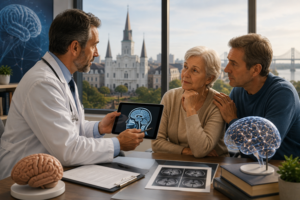
Many patients feel nervous before seeing a specialist. Understanding the process can help reduce uncertainty. Evaluation often includes:
1
Detailed Medical History
Your physician may ask about symptom onset, family history, medications, lifestyle, sleep, nutrition, and mood changes. Family members often provide valuable observations.
2
Cognitive Testing
Simple exercises evaluate memory, attention, language, executive function, and problem-solving.
3
Physical & Neurological Examination
Testing may include reflexes, coordination, strength, walking patterns, and sensory function.
4
Diagnostic Testing
Depending on symptoms, your physician may recommend blood work, brain MRI, PET imaging, sleep studies, genetic testing, or neuropsychological evaluation.
Why Early Diagnosis Matters
Many patients fear receiving a diagnosis. However, avoiding evaluation can delay interventions that may help preserve independence and quality of life.
🕐
📚
🔬
Even when cures are unavailable, supportive strategies can make meaningful differences in symptom management and quality of life.
A Holistic Approach to Neurodegenerative Care
Neurodegenerative disease affects far more than memory. As a physician and medical scientist, I’ve observed that neurological health often intersects with cardiovascular health, sleep quality, metabolic function, chronic inflammation, nutrition, stress, addiction recovery, and social support.
Holistic medicine does not replace evidence-based care. Rather, it broadens the framework to address the whole patient. Treatment may include:
💊
🥦
🧩
🏃
😴
👨👩👧
🧠
"The goal is not simply extending life, but preserving dignity and function."
Questions to Ask a Neurodegenerative Specialist
Patients and families should feel comfortable asking:
- What condition do you suspect?
- Are additional tests needed?
- What treatment options are available?
- How quickly may symptoms progress?
- What lifestyle changes could help?
- Are clinical trials appropriate?
- What support resources exist?
Open communication improves outcomes and empowers patients.
Final Thoughts
Searching online for a dementia specialist near me or an Alzheimer’s specialist near me often begins during stressful and uncertain moments. The process can feel overwhelming, but specialized care provides guidance, clarity, and a path forward.
Neurodegenerative specialists do more than diagnose disease. They help patients understand what is happening, support families through difficult transitions, and create personalized strategies for preserving quality of life.
Early evaluation matters. If you or someone you love is experiencing concerning cognitive or neurological changes, seeking expert care may be one of the most important steps toward understanding and managing the journey ahead.
Your HolisticCare Team
Prevention is the ultimate medicine.
FAQs